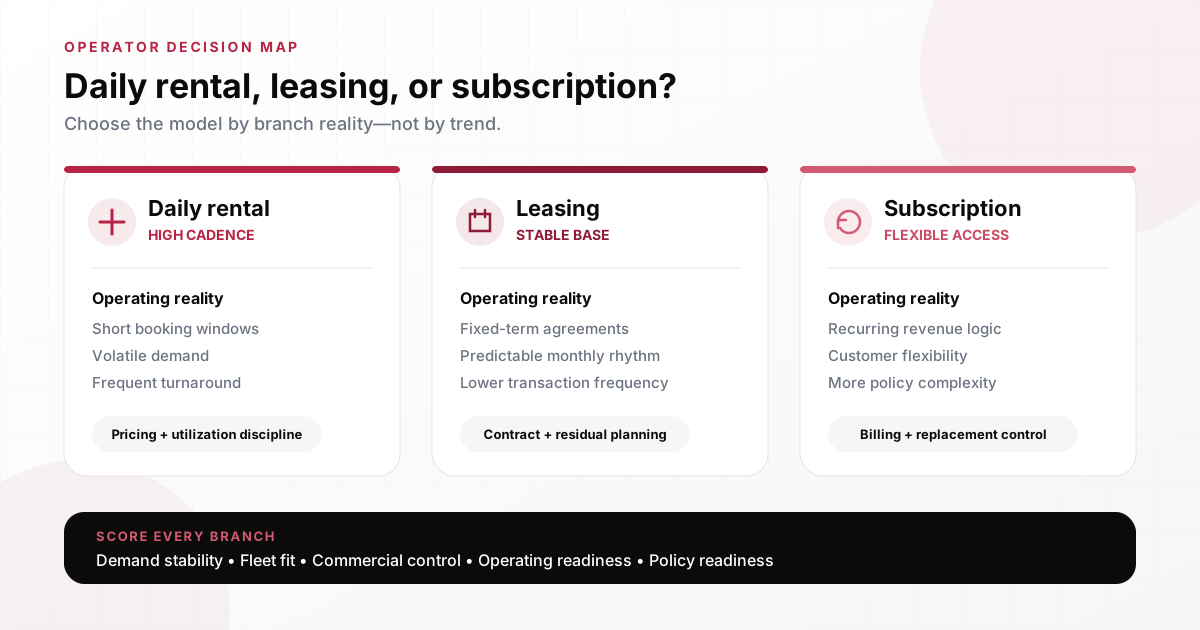
If your team keeps debating "Should we grow daily rental, launch long-term leasing, or test subscriptions?", you are really deciding your operating model.
Most operators do not fail because one model is "wrong." They struggle because they run three models with no clear role, no guardrails, and no margin discipline.
This playbook gives you a practical decision framework to select the right model mix by branch reality, fleet profile, and demand stability.
The three models in plain operational terms
Daily rental
Daily rental prioritizes short booking windows, high operational cadence, and dynamic inventory control.
Best for:
- High demand volatility
- Airport, tourism, and replacement demand
- Teams with strong turnaround discipline
Main risk:
- Margin swings when pricing and utilization are not managed together
Leasing (fixed term)
Leasing prioritizes predictable monthly revenue and lower transaction frequency per vehicle.
Best for:
- Corporate accounts and stable local demand
- Branches that need baseline cash-flow predictability
- Fleets where wear-and-tear planning is critical
Main risk:
- Reduced pricing upside when short-term demand spikes
Subscription
Subscription prioritizes flexibility for the customer while preserving recurring revenue logic.
Best for:
- Urban segments that value flexibility over ownership
- Operators with strong billing, policy, and access control
- Multi-product portfolios testing new demand lanes
Main risk:
- Operational complexity if policy, deposit, and replacement workflows are weak
Operator comparison table (proof element)
Scroll to compare every column
| Dimension | Daily Rental | Leasing | Subscription |
|---|---|---|---|
| Revenue predictability | Medium | High | Medium-High |
| Pricing upside | High | Low-Medium | Medium |
| Operational intensity | High | Low-Medium | Medium-High |
| Contract complexity | Low-Medium | High | High |
| Customer flexibility | High | Low | High |
| Idle-day risk | Medium | Low | Medium |
| Best branch context | Seasonal/high-traffic | Stable corporate base | Urban flexible demand |
Use this table as a starting map, not a final answer.
The scorecard that prevents strategy-by-opinion
Before expanding any model, score each branch from 1 (weak) to 5 (strong):
- Demand stability by segment (tourism, corporate, replacement)
- Fleet-fit (vehicle classes aligned to model economics)
- Commercial control (rate governance, override discipline, account management)
- Operational readiness (handoff, turnaround, maintenance throughput)
- Policy readiness (deposits, mileage terms, damage rules, collections)
Interpretation:
- 22-25: branch can scale mixed-model strategy safely
- 17-21: scale one lead model + one controlled secondary model
- 12-16: fix operations before adding model complexity
- <12: stop expansion and stabilize fundamentals
Recommended model mix by branch type
1) Airport or high-tourism branches
Default mix:
- Daily rental as primary model
- Limited subscription pilot for repeat local users
- Leasing only for strategic B2B accounts
Why: pricing agility and utilization management are the core advantage.
2) Corporate/industrial corridors
Default mix:
- Leasing as base revenue layer
- Daily rental for replacement and overflow demand
- Subscription only if billing and service operating targets are mature
Why: predictable utilization and account retention matter more than weekend spikes.
3) Dense urban branches
Default mix:
- Subscription and daily rental hybrid
- Selective leasing for vetted accounts
Why: customer preference often shifts toward flexibility, but only operators with strict policy control keep this profitable.
Common mistakes that destroy model economics
Mistake 1: One KPI for all models
A single utilization or revenue KPI hides reality.
- Daily rental needs demand pacing + rate quality
- Leasing needs renewal and default control
- Subscription needs churn and service consistency control
Mistake 2: No policy segmentation
If all customers get the same deposit, mileage, and extension terms, risk increases and margin leaks.
Mistake 3: Expanding subscription before workflow maturity
Subscription is not "monthly rental with a nicer label." It requires stronger policy and operational precision.
Mistake 4: Ignoring residual-value planning
Model decisions affect asset rotation timing. If finance and operations are disconnected, fleet economics erode.
90-day rollout blueprint
Days 1-30: Diagnose and baseline
- Build branch scorecards
- Separate economics by model
- Define explicit no-go conditions for expansion
Days 31-60: Controlled pilot
- Launch one branch-level pilot with weekly governance
- Set override limits and exception approvals
- Track margin quality, not bookings alone
Days 61-90: Scale or stop
- Scale only if scorecard and margin targets hold
- Freeze model expansion if operational variance increases
- Document policy updates before multi-branch rollout
FAQ
Should we pick one model and ignore the others?
Usually no. Most operators win with a deliberate mix, but one model should lead by branch.
Is subscription always more profitable than daily rental?
Not automatically. Poor policy control can make subscription look stable but underperform on true contribution.
Can leasing reduce idle days materially?
Yes, especially in stable demand corridors. But it can cap upside during high short-term demand windows.
What should leadership review weekly?
Model mix by branch, margin by model, policy exceptions, and churn/default risk.
Final decision rule
Do not ask which model is best in general. Ask which model is best for this branch, this fleet, and this demand profile.
If you need stronger control over pricing, policies, and execution rhythm, review commercial strategy, operations, car rental pricing strategy, and car rental software vs spreadsheets.
When you are ready to operationalize a mixed-model strategy with real controls, explore See how it works or Book a demo.