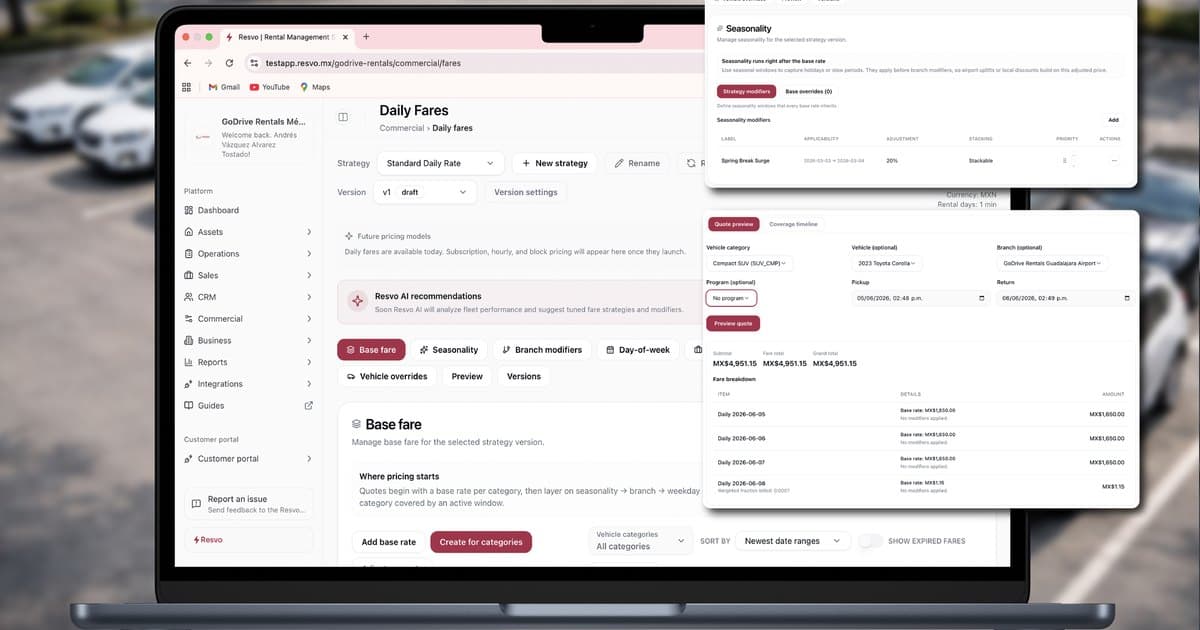
A useful car rental pricing strategy gives the team a repeatable answer to five questions: which branch, which vehicle category, which pickup window, which rental length, and which customer or channel context? It then sets a cost-informed floor, a target rate, an exception boundary, and the authority required to move between them.
That is more dependable than one fleet-wide daily price or a collection of discounts remembered by staff. It also separates a commercial problem from an operating problem. Weak bookings can come from price, but they can also come from unavailable categories, vehicles that are not ready, deposit friction, unclear terms, or a slow quote process.
This guide builds a practical rate-control model for an independent or multi-branch rental company. The formulas and examples are management tools, not accounting, tax, or legal advice. Use actual business costs and review the model with the people responsible for finance and local compliance.
The car rental pricing decision cell
Do not start a pricing review with “What should we charge for an SUV?” Start with a smaller decision cell:
branch × category × pickup window × rental length × channel or segment
Each part changes the economics or the promise:
Scroll to compare every column
| Dimension | Why it matters | Example control |
|---|---|---|
| Branch | Demand, logistics, taxes, fees, and fleet pressure can differ by location | Airport and neighborhood branches use separate rate calendars |
| Category | Cost, replacement difficulty, utilization, and customer need differ | Economy and seven-seat categories have separate floors |
| Pickup window | Weekday, weekend, holiday, and event pressure are not equal | Friday afternoon has a different target than Tuesday morning |
| Rental length | Long rentals change turnaround frequency and block future capacity | Weekly rate uses a minimum duration and extension rule |
| Channel or segment | Commission, acquisition cost, billing terms, and service load differ | Direct, marketplace, corporate, and replacement work are reviewed separately |
The cell is specific enough to guide a quote without creating a unique price for every customer. It also lets a manager compare like with like. A branch should not be judged against a network average when its category mix, pickup windows, or acquisition costs are different.
Build three rate layers
A pricing rule is easier to operate when it has three visible layers rather than one number.
1. Cost-informed floor
The floor is the rate below which a booking requires closer review. It should reflect the cost assumptions that management has chosen for the category and period. Possible inputs include:
- Financing, depreciation, or capital allocation.
- Insurance and protection costs.
- Maintenance and tire reserve.
- Cleaning, delivery, transfer, and turnaround work.
- Payment fees and channel commissions.
- Expected non-rented days and planned downtime.
- Variable customer-service or account requirements.
The word “floor” does not make the number complete. Some businesses include overhead allocation; others review contribution before fixed overhead. Document what the calculation contains, what it excludes, who owns it, and when it was last updated.
A simple first pass is:
cost-informed daily floor = monthly category cost allocation / expected rented days
Use the daily rate and profitability calculator to test assumptions, then replace sample inputs with the operator’s own figures.
2. Target rate
The target is the rate the team should use when the normal demand, channel, and service assumptions apply. It should sit above the floor by an amount that reflects the commercial objective and operating risk for that decision cell.
Targets can differ without becoming arbitrary. A high-pressure pickup window may require stronger protection of scarce capacity. A longer rental may justify a lower daily target because it reduces turnaround frequency, but only if it does not block a more valuable period or create an extension problem.
3. Exception boundary
The exception boundary defines how far and why a rate can move away from target. It should name the person who can approve the move and the evidence that must be recorded.
Scroll to compare every column
| Rate position | Typical authority | Required record |
|---|---|---|
| At or above target | Sales employee under current rules | Quote version and normal reason code |
| Between target and floor | Branch manager within a set band | Reason, duration, channel, and approval identity |
| Below cost-informed floor | Commercial or finance authority | Written rationale, amount, compensating condition, and review date |
This is not a universal approval design. It is a starting structure. A rental company should set bands that match its own controls and risk tolerance.
Use contribution as a commercial lens
Headline rental revenue can hide channel and service costs. A simple contribution lens helps compare bookings with different acquisition paths:
booking contribution lens = collected rental revenue - channel cost - payment fees - direct turnaround cost - other variable service cost
This is not the same as net profit. It does not automatically include taxes, fixed overhead, depreciation policy, financing structure, claims, or every cost required for financial reporting. Its purpose is narrower: compare commercial choices using a consistent set of inputs.
Review the formula by booking and by decision cell. A direct booking and a marketplace booking may show the same customer-facing price but leave a different amount after commission and payment cost. A corporate account may accept a lower rate while adding delivery, billing, credit, or reporting work. The rate rule should see those differences before an exception becomes normal practice.
Separate demand signals from readiness signals
Low utilization does not prove that the rate is too high. It can reflect a problem elsewhere in the rental record.
Scroll to compare every column
| Signal | Possible commercial reading | Possible operating reading | Check before changing price |
|---|---|---|---|
| Many searches, few quotes | Offer or response path may be unclear | Team may lack enough availability context to quote | Inquiry completeness and quote response time |
| Many quotes, few acceptances | Total, deposit, or conditions may be weak for the segment | Quote may expire or lose ownership | Quote versions, expiry, follow-up, and lost reason |
| Low utilization | Target may exceed demand for the window | Vehicles may be in maintenance, transfer, cleaning, or uncertain return states | Sellable capacity by category and time |
| High bookings, weak contribution | Discounts or channel cost may be too high | Extensions, delivery, and turnaround may cost more than assumed | Collected amount and variable cost by booking |
| Frequent overrides | Target or band may not fit the market | Authority may be unclear and staff may be solving readiness gaps with price | Override reason, approver, branch, and outcome |
Before reducing a rate, review car rental availability management. It explains why present, ready, committed, and sellable vehicles are different states. Discounting a category whose units are not ready will not repair the capacity record.
Price by channel after its actual cost
Channel strategy should compare the whole booking path, not only the published daily rate.
Direct booking
Review payment fees, promotion cost, customer-service load, abandonment, and the value of owning the relationship. A direct channel can support clearer policies and future follow-up, but that does not make every direct booking inexpensive.
Marketplace or broker
Record commission, cancellation conditions, payment flow, customer expectations, and which party communicates the final terms. The European Commission reported recurring complete-price and rental-condition problems in a review of broker websites. The finding is regional, but the operating lesson is broad: compare and present the total price and conditions clearly. See the Commission’s car-rental broker transparency findings.
Corporate or partner account
Measure the account’s actual rental pattern, billing terms, delivery work, negotiated extras, vehicle-class needs, and payment timing. Volume alone does not explain whether a lower target is sound.
Replacement or insurance work
Review admin time, approval flow, extension frequency, delivery or collection, and the risk of a rental continuing beyond the planned window. The operational load can matter as much as the headline rate.
Use direct booking versus OTA economics to map the tradeoffs before changing the whole rate calendar.
Connect rate rules to quotes
A rate rule only creates control if the quote preserves the inputs used to choose it. A message containing one total is not enough.
Every material quote revision should keep the branch, dates and times, category, price breakdown, deposit or authorization, included items, exclusions, availability basis, validity, customer action, and exception approval. The car rental quote template shows the full 10-field record and a practical revision model.
General quote systems also use explicit lifecycle states. Stripe’s quote lifecycle documentation separates draft, open, accepted, and canceled states and keeps revision history. That is useful as a state example. A rental company still needs its own availability, category, readiness, deposit, and booking-confirmation controls.
When a customer changes the return time or branch, do not edit the old offer invisibly. Create a new version, rerun the relevant rate and availability checks, and state the action required from the customer. Acceptance should not be presented as a confirmed booking until the configured booking conditions are complete.
Define discount and override authority
Uncontrolled exceptions can create a separate pricing strategy in every branch. A short authority matrix should answer:
- Which employees can quote the target rate.
- How far a branch manager can move within an approved band.
- Which reasons are allowed for an exception.
- Which changes require commercial or finance review.
- Whether a longer minimum rental, different deposit, or other condition accompanies the exception.
- How long the approval remains valid.
- Which quote version contains the approved terms.
- How exceptions are reviewed after the rental closes.
Useful reason codes are concrete: approved account rate, vehicle-age plan, long-rental band, service recovery authorized by a manager, dated campaign, or category substitution. “Customer asked” is context, not a complete approval reason.
Keep consequential decisions under authorized human or workflow control. An assistive system may surface the rule, compare context, prepare a quote, or flag an out-of-band request. It should not silently change a commercial term or commit scarce capacity outside the configured authority.
Worked example: one category at two branches
The following figures are illustrative and use a generic local currency. They are not a benchmark or expected result.
A rental company reviews the same compact category for a city branch and an airport branch during a Friday-to-Monday window.
Scroll to compare every column
| Input | City branch | Airport branch |
|---|---|---|
| Cost-informed daily floor | 520 | 570 |
| Normal target for the window | 690 | 790 |
| Direct payment and variable service cost | 45 | 65 |
| Marketplace commission and variable service cost | 150 | 205 |
| Sellable units at review time | 8 | 3 |
| Open quotes for the same window | 4 | 7 |
The airport branch has fewer sellable units and more open demand. That does not dictate a price on its own, but it supports protecting the target and limiting broad discounts. The city branch has more capacity, yet the manager still checks why units are open before lowering the rate.
A corporate customer then asks for a 12-day rental from the city branch. The account rule allows a target of 640 for that duration. A sales employee prepares the quote at the approved target. When the customer requests 590, the quote moves into the manager band. The manager records the account, dates, remaining category capacity, billing terms, reason, and approval on revision two.
At the airport branch, a marketplace booking at a customer-facing rate of 790 carries higher channel cost. The team compares its contribution lens with a direct booking at the same rate. It does not assume that identical prices create identical economics.
The point is not that one branch must charge more. The point is that both branches use the same decision structure while working from their actual demand, capacity, channel, and authority context.
Run a weekly pricing review
A weekly meeting should end with named rate-rule changes, owners, and effective dates. Use a compact review packet:
- Sellable capacity and utilization by branch, category, and pickup window.
- Quotes sent, accepted, expired, and closed by reason.
- Collected rental revenue and the chosen contribution inputs by channel.
- Overrides by branch, employee, band, reason, and approver.
- Extensions, late returns, transfers, and downtime that changed capacity.
- Customer questions or disputes about total price, deposit, extras, or conditions.
- Rate-rule decisions, start date, owner, and next review date.
Avoid reacting to one noisy week without context. Compare a consistent period, note events or fleet disruptions, and record why the rule changed. The next meeting should be able to distinguish a deliberate test from informal drift.
Track indicators that connect price to the wider rental operation:
- Quote-to-booking rate by decision cell.
- Average time from qualified inquiry to sent quote.
- Rate of expired quotes without a recorded next step.
- Difference between quoted and collected rental amounts.
- Override frequency and distribution by reason.
- Utilization and sellable capacity by category.
- Contribution lens by channel or account type.
- Extensions or late returns that affected the next booking window.
These are diagnostic signals. None should be used alone as a target that pushes staff to hide an exception or weaken a customer condition.
Install the pricing model in 30 days
Week 1: document current economics
Choose one high-volume category at one branch. Define the cost-informed floor inputs, exclusions, owner, expected rented days, channel costs, and current target. Reconcile the model with the finance team before staff use it.
Week 2: publish the decision cell and authority
Add branch, pickup window, rental length, and channel or segment. Define the normal target, manager band, higher approval boundary, allowed reasons, and evidence required.
Week 3: connect quotes and availability
Require quote versions to preserve the rate input, availability basis, validity, approval, and customer action. Test what happens when dates, category, branch, or return time changes.
Week 4: review outcomes and expand carefully
Run the weekly packet. Separate commercial from readiness causes. Correct unclear inputs before adding more categories or branches. Expand only when employees can explain the current rule and managers can reconstruct an exception.
Frequently asked questions
What is the first step in a car rental pricing strategy?
Define one decision cell and a documented cost-informed floor. State which costs are included and excluded. Then add the target rate and exception authority for that branch, category, pickup window, rental length, and channel or segment.
Should a rental company match competitor prices?
Competitor prices are context, not the operator’s economics. Compare total customer terms, category, dates, channel, and service scope, then test the rate against the company’s own floor, capacity, target, and authority rules.
Does low utilization mean rates are too high?
Not by itself. Low utilization may reflect price, weak demand, unavailable categories, maintenance, cleaning, transfer, uncertain returns, deposit friction, or slow quote follow-up. Check sellable capacity and the quote funnel before changing the rate.
How often should car rental rates change?
The review cadence should match demand and operating volatility. Many teams can use a weekly rule review with defined event or holiday calendars. Whatever the cadence, record the owner, reason, effective window, affected cells, and next review date.
How can AI assist a rental pricing review?
An assistive workflow can organize signals, compare configured rules, surface exceptions, and prepare a recommended next action. Pricing changes, exceptions, scarce-capacity commitments, and other consequential decisions should stay inside the operator’s configured permissions and approvals. Resvo’s AI Revenue Optimizer is On request for a scoped first deployment; it should not be presented as a generally live automated pricing capability.
Where Resvo fits
Resvo is a Rental Management System and operating record for the rental lifecycle. Its Commercial Strategy area connects fares, seasonal plans, deposits, policies, fees, discounts, contracts, and approval controls to bookings and payments. Availability, quote, branch, category, and collected-payment context can remain attached to the same rental work instead of being rebuilt across spreadsheets and chat.
The operator still owns the commercial strategy, approvals, and judgment. Resvo supplies the connected record and configured mechanism that help the team apply those decisions consistently. To test the workflow, book a demo with one category, two branches, and a recent quote exception.