A weak car rental late return policy quietly destroys economics.
Most operators can spot obvious losses like damage or chargebacks. Fewer teams measure how much margin disappears when late returns are handled with inconsistent rules, manual exceptions, or branch-by-branch improvisation.
If your operation wants healthier utilization, fewer handoff conflicts, and cleaner customer communication, late-return control needs to be treated as an operating system, not a penalty line in a contract.
Why late returns are an operating issue, not just a billing issue
Late returns do more than add one fee dispute. They ripple into:
- delayed handoff for the next reservation
- rushed or skipped turnaround checks
- overtime pressure on branch teams
- compensation costs (upgrades, discounts, or cancellations)
- lower trust when customers feel policy is unclear
When leadership treats this as “just charge the extra hour,” teams solve symptoms, not the root process.
The Late Return Control Model (4 layers)
Use this model to make policy predictable and enforceable:
Scroll to compare every column
| Layer | Objective | Minimum standard |
|---|---|---|
| Policy architecture | Define fair, defendable rules | Grace window + billing thresholds documented |
| Booking transparency | Set expectation before payment | Late-return terms visible before checkout |
| Branch execution | Apply rules consistently on the ground | Start/stop timestamps + reason codes |
| Exception governance | Prevent arbitrary fee waivers | Approval matrix + weekly review |
Most leakage happens when operators have a written policy at layer 1 but fail at layers 2-4.
Build policy around a clock model your team can execute
A strong late-return policy does not need to be punitive. It needs to be consistent.
Use a simple three-zone clock model:
- Grace zone (example: 0-29 minutes): no fee, logged event
- Partial-use zone (example: 30-119 minutes): fixed short extension fee
- Rate-conversion zone (example: 120+ minutes): convert to additional day or dynamic extension logic
The exact thresholds depend on your market and turn pressure, but the structure should stay fixed.
Policy design checklist
Before launching or revising your policy, confirm:
- grace window is explicitly defined in minutes
- fee logic is tied to product class and day type
- extension path is available in-app or via support
- no-show and late-return rules do not contradict each other
- branch agents can explain policy in one sentence
If your own team cannot explain it quickly, customers will not trust it.
Connect late-return policy to utilization planning
Late returns hurt most when downstream bookings are tightly stacked.
Run late-return risk by demand condition:
Scroll to compare every column
| Demand condition | Risk if policy is weak | Control to prioritize |
|---|---|---|
| High occupancy windows | Next booking delay, forced upgrade, cancellation risk | Tighter extension cutoffs + proactive reminder sequence |
| Medium occupancy | Manageable disruption but avoidable labor drag | Clear partial-use fees + branch dashboard alerts |
| Low occupancy | Revenue leakage through inconsistent waivers | Enforce consistent logging and exception controls |
This is why late-return policy should be reviewed with utilization data, not only with finance reports.
For broader commercial alignment, pair this with car rental pricing strategy and car rental fleet maintenance checklist.
Design communication that prevents conflict before return time
Most fee conflicts are communication failures before they become payment disputes.
Minimum communication sequence:
- confirmation message includes return timestamp and grace window
- pre-return reminder sent with extension link/options
- post-threshold message confirms fee tier activated
- final invoice displays exact timing and policy reference
If this flow is fragmented across channels and staff, your dispute risk increases even when the fee itself is valid.
Standardize branch behavior with reason codes
Free-text explanations create chaos. Use normalized reason codes so leadership can actually diagnose patterns.
Suggested starter set:
- LR-TRAFFIC (traffic/road congestion)
- LR-CUSTOMER-REQUEST (requested extension)
- LR-NO-COMMS (no communication before threshold)
- LR-BRANCH-DELAY (operational delay at return desk)
- LR-VEHICLE-ISSUE (mechanical issue affecting return)
- LR-WAIVER-AUTH (approved waiver)
Without reason codes, “late return” looks like one problem when it is usually five different problems.
Use an exception matrix to protect trust and margin
The goal is not rigid punishment. The goal is fair consistency.
Scroll to compare every column
| Scenario | Recommended treatment |
|---|---|
| First-time delay inside grace zone | No fee, log event |
| Repeat short delays from same account | Apply partial-use fee + education message |
| Delay caused by documented branch bottleneck | Waive fee with reason code and manager approval |
| Delay affecting high-demand turn and no communication | Apply full policy tier and document evidence |
This prevents both extremes: random waivers and robotic enforcement.
KPIs that reveal late-return health
Track these weekly by branch:
- late-return rate (% of reservations)
- average delay minutes by vehicle class
- fee capture rate (% policy-eligible events billed)
- waiver rate by manager/reason code
- downstream disruption rate (next booking delayed/canceled)
If late-return rate is flat but downstream disruption keeps rising, your scheduling buffers are likely too thin.
30-day rollout plan for operators
Week 1
- Define or tighten grace/partial/day-conversion thresholds
- Update checkout and booking confirmation language
Week 2
- Launch branch reason codes and exception matrix
- Train front desk and support with 30-minute role play
Week 3
- Activate reminder and extension flow automation
- Review first wave of waiver behavior by branch
Week 4
- Publish KPI snapshot and policy adjustment decisions
- Lock one improvement for next cycle (not ten)
This cadence creates measurable control without heavy operational shock.
Where Resvo fits
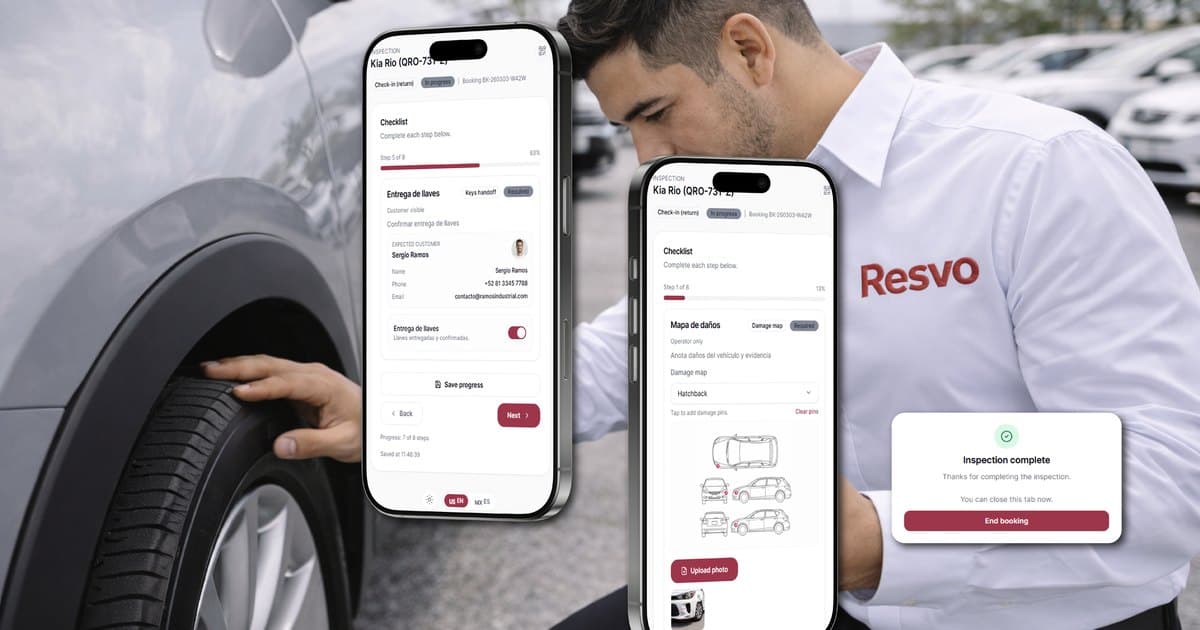
Resvo helps operators connect booking terms, timestamps, extension workflows, payment events, and branch exception governance in one operational record.
That connection is how late-return policy becomes predictable, defensible, and scalable across locations.
To strengthen adjacent controls, continue with car rental chargeback prevention, car rental software with online booking, and See how it works. When you want to standardize this policy across branches, Book a demo.
Source references
- U.S. Federal Trade Commission: Vehicle Rental Scams and Consumer Rights
- Your Europe: Hiring and driving a car in another EU country
- Chargebacks911: Chargeback causes and prevention patterns