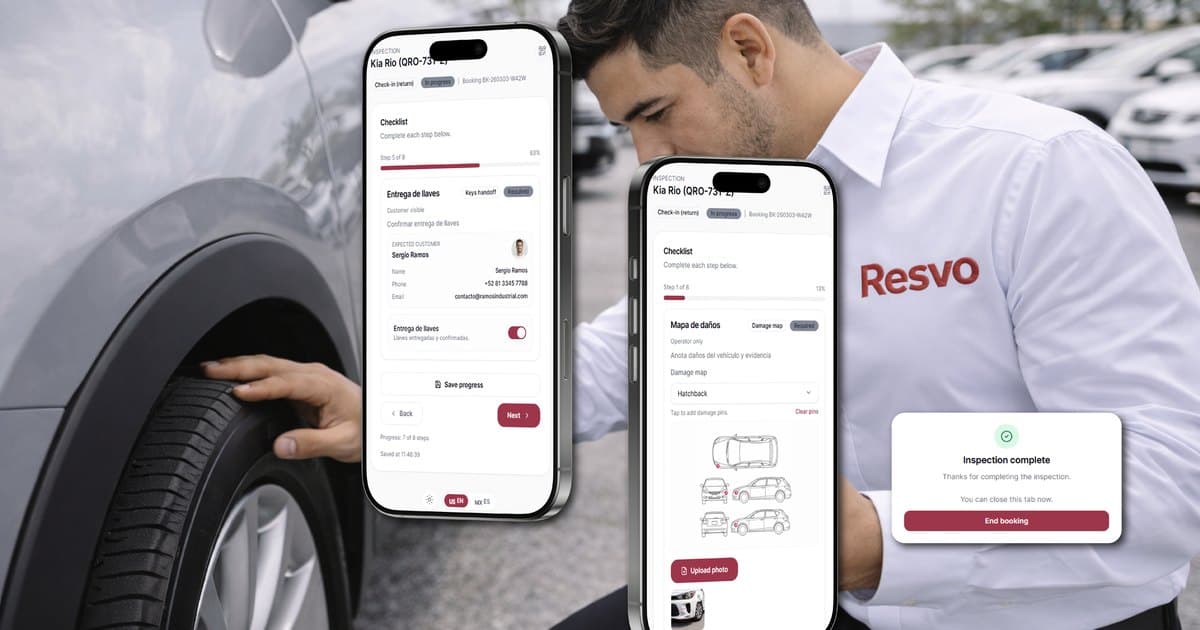
A car rental fleet maintenance checklist should connect service timing with the bookings the fleet must support. It gives staff one way to capture observations, plan work, assign follow-up, and preserve evidence without asking a branch employee or a spreadsheet to make a technical decision.
The checklist is not a universal inspection standard. Vehicle models, manufacturer schedules, local rules, fleet age, duty cycle, and the operator's qualified staff all change what must be checked and who may release a unit. Use this guide to design the operating record around those requirements—not to replace them.
The practical outcome is clarity. Sales can see when planned work affects capacity. Branch staff know what to record at return. Maintenance coordinators see the next service trigger and missing dependency. Authorized people keep the judgment about diagnosis, repair, safety, and release.
Give each maintenance layer a clear job
One giant checklist usually fails. It asks a branch employee to perform technical work, repeats the same fields at every handoff, and hides the reason for each observation. Separate the process into four layers:
Scroll to compare every column
| Layer | Trigger | Purpose | Resulting record |
|---|---|---|---|
| Pickup and return observation | Every handoff | Capture visible condition, warnings, customer reports, fuel or charge, mileage, and new evidence | Handoff record with any follow-up task |
| Scheduled service review | Time, mileage, usage, or manufacturer/operator rule | Identify work approaching under the approved maintenance plan | Planned service window and owner |
| Qualified assessment | An observation, alert, repeat issue, recall notice, or service event needs review | Diagnose, scope, or decide the authorized next step | Assessment and work order |
| Return-to-operation review | Work or required evidence is reported complete | Confirm the operator's release requirements and resulting vehicle state | Authorized release or continued block |
This separation keeps scope honest. A counter employee may note that a warning indicator appeared. The qualified reviewer determines what it means and what action follows. Software can require a photo or timestamp; it cannot certify the vehicle.
If a finding blocks the unit, move it into the rental fleet downtime control playbook. That companion guide covers owner, booking exposure, waiting states, recovery work, and release. This checklist stays focused on prevention and evidence collection.
Build the maintenance master record first
Before adding tasks, make sure every vehicle has a usable maintenance profile. At minimum, preserve:
- Internal vehicle ID and registration identifiers
- Make, model, model year, powertrain, and operator-defined category
- Current location and custody
- Current odometer or other relevant usage measure, with source and update time
- Applicable manufacturer schedule and source version
- Operator maintenance plan and approved deviations
- Warranty, service-plan, or provider context when relevant
- Open recalls or manufacturer notices and the last official check date
- Qualified roles allowed to assess, approve work, and release the unit
- Preferred and backup provider by location
- Active bookings, protected future commitments, and branch/category capacity context
Avoid copying an old spreadsheet interval into the new record without confirming its source. Record whether the next trigger comes from a manufacturer schedule, operator policy, vendor instruction, telematics source, manual reading, or another approved input.
Use a handoff observation checklist
Pickup and return are reliable moments to collect information because staff already interact with the vehicle and rental record. Keep this checklist observational unless the employee is qualified and assigned to do more.
Vehicle and trip context
- Vehicle ID, branch, date, time, and employee
- Rental or movement record connected to the handoff
- Odometer and fuel or charge reading under the operator's procedure
- Customer-reported issue in the customer's words
- Current warning or message observed, recorded without an invented diagnosis
Exterior and visible condition
- New visible damage or change from the prior evidence
- Tire appearance or reported issue that requires review
- Glass, mirror, light, or body observation
- Fluid on the ground or another visible sign that needs escalation
- Photos or video required by the operator's evidence rule
Cabin and usability observations
- Controls, indicators, cleanliness, odor, or customer-reported behavior that needs follow-up
- Missing equipment or vehicle documents under the branch checklist
- Fuel, charging, key, or accessory issue affecting the next preparation step
- Any observation that activates the operator's block or qualified-review rule
Every flagged item needs a disposition: no follow-up under the policy, branch preparation task, qualified review, scheduled work, immediate block, or another operator-defined route. “Noted” is not a disposition.
Connect damage observations to a separate vehicle damage documentation process. Damage, maintenance, customer responsibility, insurance, and release may share evidence, but they are not the same decision.
Plan scheduled service against real demand
A due date without capacity context creates avoidable conflict. For every upcoming service event, record:
Scroll to compare every column
| Planning field | Why it matters |
|---|---|
| Trigger and source | Shows why the service is due and which rule controls it |
| Earliest and latest approved window | Gives operations room to plan without silently extending a technical limit |
| Current location | Determines provider, movement, custody, and branch impact |
| Expected work scope | Helps reserve time, parts, approvals, and evidence |
| Category and branch pressure | Shows which customer commitments need protection |
| Current and next owner | Prevents the task from waiting between teams |
| Provider and appointment state | Separates a planned event from a confirmed slot |
| Required completion evidence | Defines what the provider and reviewer must return |
| Release authority and next state | Keeps workshop completion separate from usable capacity |
Review the car rental availability management rules before moving a service window. An expected return or apparent spare unit may already support another booking. The best day for the workshop is not always the best day for the rental operation.
Do not let booking pressure erase a service requirement. If the timing conflicts, route the exception to the person authorized to choose among approved alternatives. Preserve the original trigger, decision, reason, and resulting plan.
Turn every service event into a controlled work order
Whether the work happens in-house or with a vendor, the operating record should answer the same questions:
- What vehicle and condition or trigger does the work cover?
- What facts and evidence were available at intake?
- Who assessed the issue and under what qualified role?
- What work was proposed and approved?
- Who approved cost or scope when approval was required?
- Which provider has custody, and when did custody change?
- What parts, appointment, access, or information are still missing?
- When is the next review or promised update?
- What completion evidence must return?
- Who reviews the evidence and decides the next vehicle state?
Keep the original observation separate from assessment and completed work. For example, “customer reports vibration” is an observation. A diagnosis belongs to the qualified reviewer. An invoice line shows billed work, but the operator may still need a release review before the vehicle returns to availability.
Define an evidence gate without automating judgment
Evidence should prove that the required record is complete enough for the authorized person to review. Depending on the work and policy, the gate might require:
- Work order number and vehicle match
- Provider and qualified person identity
- Service dates and custody history
- Recorded odometer or relevant usage
- Approved scope and completed-work notes
- Part, fluid, measurement, or procedure record required by the operator
- Photos, test result, invoice, or other source document
- Open item, follow-up date, or restriction
- Reviewer identity and decision time
An automated completeness check can surface a missing document, stale reading, mismatched vehicle ID, or absent signature. It should not decide that a repair is correct, that a vehicle is safe, that damage responsibility is settled, or that a booking may proceed. Those decisions remain with the people and policies the operator has authorized.
Include recalls in a separate control
Routine service and safety recalls are not interchangeable. Create a distinct field for the last official recall check, the source, any open notice, and the approved response.
In the United States, NHTSA's official recall lookup supports searches by VIN or license plate for unrepaired recalls from participating manufacturers. In Mexico, Alerta Rápida Profeco publishes current notices and links to provider details. Use the official source that applies to the vehicle and jurisdiction, plus manufacturer instructions and local requirements.
Do not assume that “no result” proves every maintenance question is closed. Record the check time and source, keep recall work separate from routine service, and follow the approved route for any notice.
Install exception rules before the week gets busy
The normal path is simple: trigger, plan, appointment, work, evidence, authorized review, resulting state. Real fleets need a clear route when that path breaks.
Scroll to compare every column
| Exception | Information to gather | Required operating decision |
|---|---|---|
| Service becomes due near a protected booking | Trigger source, approved window, booking pressure, alternative capacity | Authorized timing or capacity plan |
| Provider misses the update time | Current custody, last response, open dependency, booking exposure | New owner, review time, provider or recovery path |
| Scope or cost changes | Assessment, revised work, supporting evidence, approval limit | Approve, question, redirect, or pause under policy |
| Part is unavailable | Part and source, expected update, alternate provider, vehicle and category pressure | Waiting plan, escalation, or approved alternative |
| Evidence is incomplete | Missing item, provider response, review authority | Keep review pending or request completion |
| Same observation returns | Previous records, work performed, elapsed use, current finding | Qualified reassessment and fleet-planning review |
Write the authority boundary next to the exception. The system can route and remind. The responsible person still owns the judgment.
Run a daily and weekly operating rhythm
Daily exception review
Look only at work that can change today's capacity or has missed a promised update:
- Newly flagged handoff observations
- Service due inside the active planning window
- Vehicles blocked from availability
- Appointments not confirmed
- Work orders waiting for approval, part, vendor, or transport
- Provider update times that have passed
- Completed work waiting for evidence or authorized review
- Future bookings depending on an expected return from service
End the review with a named owner and time. If the unit is blocked, use the downtime control record instead of burying it in the service list.
Weekly pattern review
Study causes and handoffs across vehicles:
- Which planned services entered the booking window without a confirmed plan?
- Which observations repeated on the same vehicle or model group?
- Where did work wait longest: assessment, approval, provider, part, evidence, or release review?
- Which categories or branches had the least room to absorb service?
- Which provider updates arrived late or incomplete?
- Which checklist item created noise without changing a decision?
- Which source dates, maintenance rules, or role permissions need review?
Connect the review to the fleet utilization playbook. Keep unavailable time visible by reason instead of removing it only to improve the percentage.
Use metrics with definitions, not universal targets
Start with a baseline from your own fleet. Record the calculation and exclusions so the result remains comparable.
Scroll to compare every column
| Metric | Working definition | What to inspect behind it |
|---|---|---|
| Planned service on-time rate | Planned events completed within the operator's approved window divided by due events | Source accuracy, booking conflicts, provider capacity |
| Open maintenance work by state | Count of open records grouped by current state | Unowned work and growing queues |
| Waiting time by dependency | Recorded time waiting for approval, provider, part, transport, evidence, or review | Broken handoffs rather than repair complexity |
| Booking exposure from maintenance | Protected commitments that required capacity action because of planned or open work | Planning horizon and category buffer |
| Repeat observations | Recurring observation classes by unit or group in a defined review period | Qualified technical and replacement review |
| Evidence completeness | Closed work orders containing the operator's required review fields | Provider process and internal review discipline |
Do not publish an industry benchmark unless its source, fleet definition, period, and calculation match your use. A younger urban fleet and an older fleet operating long distances should not inherit the same target from a generic article.
Copy this checklist structure
Use the following as a design prompt for your RMS or operating sheet:
Vehicle and current branch:
Trigger type and source:
Trigger date / mileage / usage:
Applicable schedule or operator rule:
Observation and reporter:
Evidence captured:
Disposition under policy:
Current vehicle state:
Service window and booking exposure:
Work order / provider / custody:
Current owner and next action:
Next review date and time:
Approval or dependency missing:
Completion evidence required:
Authorized reviewer and decision:
Resulting state and follow-up trigger:
Pilot it with one branch or vehicle group. Observe where employees still return to chat, memory, or a separate file. Add only the fields that resolve a real handoff or decision.
A four-week implementation sequence
Week 1: map triggers and authority
List current schedules, observation points, block rules, providers, and the people authorized to assess, approve, and release. Confirm the source for each service trigger.
Week 2: standardize records
Install the maintenance master record, handoff observation, work order, evidence gate, and exception route for a small group of vehicles. Do not migrate every historical note before the active flow works.
Week 3: connect booking capacity
Add service windows and blocked vehicles to the branch/category planning view. Test how the team handles one due service, one delayed provider, and one exposed booking.
Week 4: review and simplify
Compare planned work, waiting states, repeated observations, evidence gaps, and capacity actions. Remove duplicate fields and clarify any authority boundary that still sends staff to private messages.
How Resvo supports the maintenance workflow
Resvo is a Rental Management System built around one operating record. Its live Fleet Management & Operations capabilities include vehicle records, maintenance orders, service notes, inspections, movements, vehicle status, downtime visibility, and the Booking Command Center. That connection helps an operator see planned work and open exceptions alongside reservations and branch pressure.
Resvo does not replace the operator's maintenance program, manufacturer requirements, qualified staff, provider judgment, or release authority. The operator configures the workflow and remains responsible for those decisions.
Frequently asked questions
What belongs in a car rental fleet maintenance checklist?
Include the vehicle and trigger source, handoff observations, evidence, disposition, service window, booking exposure, owner, next action, work order, dependencies, completion evidence, authorized review, resulting state, and follow-up. The technical inspection items must come from the approved program for the vehicle and jurisdiction.
Should branch staff diagnose a reported problem?
Only if they are qualified and authorized for that task. An operational checklist can ask staff to record the customer's words, visible indicators, timestamps, readings, and evidence, then route the item to the correct reviewer.
How often should a rental vehicle be serviced?
Follow the applicable manufacturer schedule, local requirements, approved operator policy, vehicle usage, and qualified advice. Do not copy one interval across models or duty cycles without verifying it.
When should maintenance remove a vehicle from availability?
Use the block rules and decision authority documented by the operator. Once blocked, keep the availability state aligned until the required review records a change. Sales pressure should not silently override the block.
Is a completed work order enough to rent the vehicle again?
Not always. The operator may require evidence, authorized review, movement, cleaning, inspection, fuel or charge, or another readiness step. Record workshop completion and availability release separately.
If maintenance work is still separated from bookings and branch capacity, book a Resvo demo and map one service event from trigger to authorized release.