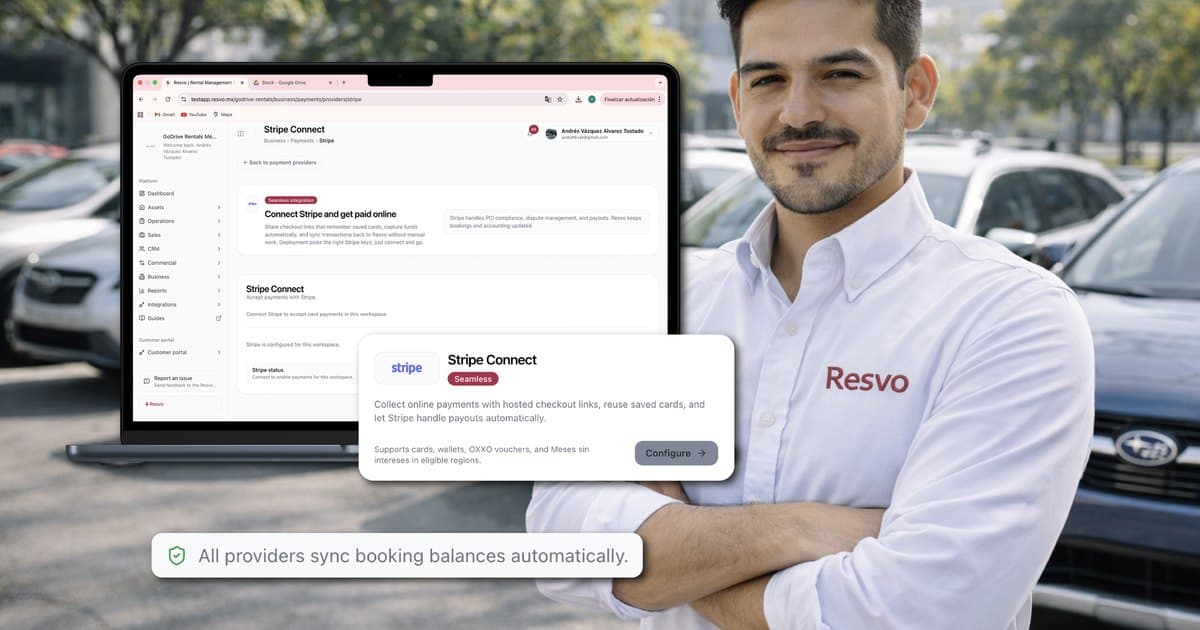
If you are searching for car rental software with Stripe, the real question is not whether Stripe can take a payment. It is whether the payment workflow actually supports rental operations: deposits, refunds, late-return adjustments, damage evidence, and clean reconciliation.
That distinction matters. In rental, payment is not a one-time event. It is a sequence:
- Reserve
- Deposit or authorization
- Pickup
- Return
- Adjustment or release
- Refund or final capture
- Accounting close
If Stripe is connected loosely, the team ends up tracking the important parts outside the booking record. That is where disputes, refund confusion, and weak evidence start to pile up.
What a real rental payment flow should control
A serious integration should let the team:
- Hold or collect a deposit with the right policy
- Tie the payment event to the reservation and contract
- Attach return outcomes to any charge adjustment
- Release, capture, or refund with a visible audit trail
- Close the day with confidence that payout and reservation records match
If the booking and payment systems are disconnected, the branch can still "make it work" for a while. But every exception becomes more expensive to explain and harder to resolve later.
Deposits are not just payment events
In rental operations, deposits are part of risk management. The system should define:
- When a deposit is only authorized versus fully captured
- Which vehicle classes require different protection logic
- What happens when the customer extends, returns late, or returns with damage
- Who is allowed to override or partially refund
This is why "Stripe connected" is not enough. The payment processor can execute the movement of money, but the policy has to live inside the RMS.
Evidence should be connected before the refund decision
The most expensive failures happen after the car comes back. A connected rental payment flow should link:
- Pickup and return photos
- Mileage and fuel or charge level
- Damage notes and timestamps
- Signed or accepted contract terms
- Original deposit event
- Final charges, releases, or refunds
That evidence chain is what turns a disputed charge into an explainable one.
Refunds and cancellations must follow policy
Refund execution is a processor task. Refund logic is an operating task. Your system should support:
- Cancellation windows by channel or vehicle class
- No-show rules
- Partial refund cases
- Deposit release timing
- Damage-related capture logic
- Manager review when evidence is incomplete
Without policy, the branch improvises. And branch improvisation is how operators create inconsistency between customers, locations, and accounting records.
Map payment responsibility to the rental timeline
The payment flow gets cleaner when each moment in the rental has an owner and a clear checkpoint.
Scroll to compare every column
| Rental moment | What should already be true | Who typically owns the check |
|---|---|---|
| Quote or reservation | Rate, deposit policy, and cancellation terms are visible | Sales or reservations team |
| Before pickup | Payment status and required authorization are clear | Branch or counter staff |
| During handoff | Contract acceptance and delivery evidence are tied to the booking | Pickup agent or supervisor |
| At return | Any fuel, mileage, extension, or damage adjustment is documented first | Return agent |
| Daily close | Open exceptions and unmatched events are reviewed | Supervisor or finance lead |
When these ownership lines are blurry, the team spends more time asking who should act than actually resolving the case.
Create exception codes before disputes happen
Most payment pain comes from recurring exception types that operators treat like one-off surprises. Define a short, visible list such as:
- Customer cancelled inside policy
- No-show with deposit retention rule
- Damage review pending
- Late return adjustment applied
- Fuel or charge adjustment applied
- Duplicate charge or refund review required
Once those cases are standardized, daily closeout becomes much easier to review across branches and finance.
Standardize policy by vehicle class, not only by customer case
Payment discipline also improves when the team is not guessing policy from memory for each unit. Document a simple matrix by class or program:
- Which categories require authorization only versus full deposit capture
- Which units require higher deposit thresholds
- Which categories allow late-return grace time and which do not
- Which returns always require supervisor review before deposit release
That way the staff does not need to reinvent payment logic every time a premium unit, long rental, or replacement booking enters the branch.
Make branch closeout teachable, not heroic
The cleanest payment operations are usually boring on purpose. A branch close routine should be simple enough that a supervisor can run it consistently even on a heavy day:
- Review open deposit events before ending shift
- Confirm every adjustment has evidence attached
- Tag unresolved exceptions for next-day follow-up
- Escalate mismatches while the booking context is still fresh
When closeout depends on one highly experienced person remembering everything, the process is not actually under control.
Close the day with a real reconciliation rhythm
Monthly reconciliation is too late for rental payments. A daily closeout should make these answers obvious:
- Which reservations are paid, partially paid, refunded, or unresolved
- Which deposit events are still open
- Which Stripe events map to which reservations
- Which branch has unresolved payment exceptions
- Which payout items need accounting review
Use this quick checklist when evaluating a platform:
Scroll to compare every column
| Payment control | What to require |
|---|---|
| Deposits | Support for hold, capture, release, and audit trail |
| Refunds | Policy-driven logic with visible status history |
| Evidence | Charges and refunds tied to delivery and return records |
| Reconciliation | Reservation IDs and Stripe IDs easy to match |
| Branch closeout | Daily visibility by location, not just a global payout summary |
Payment security and provider scope
Connecting Stripe does not remove the operator's payment-security responsibilities. PCI DSS applies to organizations that store, process, transmit, or can affect the security of payment-account data. Confirm the integration model, card-data scope, staff access, retention, webhook handling, refund permissions, and reconciliation controls with the payment provider and qualified advisors.
Keep full card details out of the rental operating record. Store provider references, status, permitted metadata, and the rental context needed for reconciliation. Processor availability, authorization behavior, dispute tools, settlement timing, and supported payment methods can vary by country, account, integration, and card network.
Where Resvo fits
Resvo is a Rental Management System (RMS) built to keep pricing, contracts, inspections, evidence, and payments aligned. Stripe becomes part of the operating flow instead of a separate finance tool the team has to reconcile by hand.
For the pricing side, continue with car rental pricing strategy. For direct booking control, review car rental software with online booking. Keep financial state distinct but connected with the digital car rental agreement workflow. When you are ready to validate the payment flow with your team, See how it works or Book a demo.
Primary sources and scope
- PCI Security Standards Council: PCI Data Security Standard
- Stripe: How disputes work
- Stripe: Dispute evidence best practices
These sources explain payment-data and dispute principles. Confirm the exact Stripe products, countries, payment methods, and account configuration available to your operation.